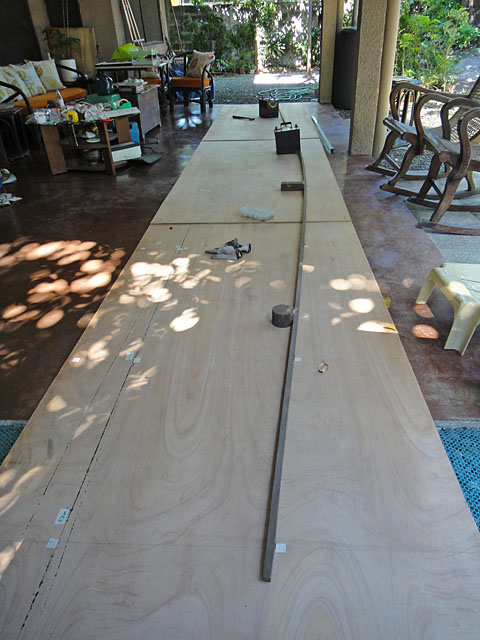
20 July 2013

Positioning the frames

in their places makes one appreciate the size of the Belhaven. 


Because of the planned modifications, temporary frames take the place of the bulkheads. Which turns out to be a good thing because the geometry of the hull after the "butterfly" is opened needs a tweak here and there to make them fit. Stitch and glue is cumbrous and unwieldy for such a large boat.

If-I-knew-then-what-I-know-now:  Should have made well-secured, external cradles at each of the bulkhead stations to help keep all the panels aligned. Too much time is spent checking, leveling, fine-tuning the components that it takes away a lot from actual building. And this has to be repeated before and after every session to make sure no errors get built in.


By end of October 2012:  With a little coaxing all the seams butt neatly and the copper wire stitches are drawn tight.

Encouraged by the the hull going 3D, a lot of work gets done at this time.

The temporary transom frame as situated in the plans straightens out the side panels.


Fitting temporary frames at Bulkhead stations 1 and 2.  Hull interior looks cavernous because the sides are 8 to 10 in. taller than original plan to allow for cutting room should I decide to increase the freeboard.


Bulkhead 3 (with quarter-berth cutout) in position. Original freeboard height is indicated by the horizontal members of the temporary frames.


View of the bow end.


The new transom temporary frame at is positioned 21 ft. with an 18 deg. rake.


By early November filleting and taping of the keel and chines are done. First, fiberglass cloth tapes are cut diagonally from stock under close monitoring by the supervisors doing night duty.


Then masking tape is applied to the outside seams so filleting goo doesn't leak to the floor and stitching wire ends are capped with foam after drawing blood enough times.

The webbing around the hull is hooked up to a chain block at the rafters; the hull can be raised if the keel stitches need to be manipulated.


Finally filleting the inner corners of the joints with a mixture of equal parts fumed silica and wood flour added to epoxy until it's stiff enough not to run. The fillet is then taped over with three layers of fiberglass.

The car batteries are to hold down a slight hump that formed at the junction of the 6mm-9mm scarf when the "butterfly" was unfolded.


19 July 2013

Unfolding the "butterfly"

turned out to be a bit of a challenge--especially when you single-hand it. 


Having a lot of exposed purlins, joists and trusses helps when rigging hoisting blocks.

The assembly is centered in the work area, resting on wooden blocks. The whole length of the keel joint has been loosely stitched at this point. Support posts have been removed on starboard side.


First attempt at opening the "butterfly" proves unsuccessful--the panels are too floppy to hold the shape by themselves despite the support lines. Previous experience of doing this with smaller boats prove inadequate; this is an entirely new adventure.

At 24 ft. the panels are left long to see the feasibility of increasing the hull length from 19 ft. to 21 ft.


Take 2 involves making bottom supports at the bulkheads no 2 and 3 positions.


It's still wobbly but the chines can now be stitched.

Picking up from nine months ago

to post the progress of the build since then.


Hard to imagine how fast nine months slip past. And as has happened in my previous builds, it has progressed in periods of furious activity followed by long stretches of calm.  More pressing matters, unfavorable weather, sometimes inexplicable lassitude would trip the enterprise into a hole and the longer it stays there the more ponderous it is to carry on. Though once the impulse kicks in, the momentum would propel it to a new level.


Early October 2012. Another Ooops! moment upon finding out a mismatch of the bow-end scarfs.


A quick butt joint adds the missing material that will eventually be filleted and taped over.


The offending panel is trimmed to match the correct one and we are back on track.


By late October 2012 the bottom and side panels are assembled into what the Graham Byrnes the designer calls the "butterfly."

The corresponding panels are laid out in the boatshed, stacked together and the bow joint taped.


As per original design, the forward ends of the bottom panels are 5 mm ply (unlike the rest of the bottom panels which are 9 mm) so they are flexible enough to follow a natural bend when the "butterfly" is unfolded.


Keel joint is loosely stitched, temporary braces are screwed on to hold up the side panels and the hoisting lines rigged to blocks at the roof joists.


And up she goes.


One finally gets to see how big this boat is going to be.


The "butterfly" joint at the chine has been reinforced with a small block to take the stress of unfolding.

A length of 1x2 keeps the top edge of the shear at the bow flat. Without it that portion waves like a flag.


01 October 2012

With circumstances and the weather cooperating

a few more steps are taken on this long journey:  


bulkhead #1 mock-up; transom mock-up to act as temporary frame so the new extended transom can be spiled; temporary frame as specified in the plans; and bulkhead #3.  The frame sides are kept long to accommodate the increased freeboard.


Bottom panels laid out for a final check before gluing the scarfs. 


The starboard bottom panels glued up.


A flaw in the plywood is discovered as the port bottom panels are to be glued together.  Probing with the strip shows the delamination to be only about 4 in. x 8 in. but must be repaired before continuing.


All the joints are scarfed.


16 May 2012

First Cut

As milestones go this marks the confirmation of the commitment.

As the plank outlines are drawn, one gets a good idea of its size.


There is no turning back.  All the bottom planks have been cut.


17 June 2011

It's got to begin somewhere

so it might as well be on the lofting floor.

The supervisor looks on approvingly but expects a faster pace but a project like this has a life of its own.